
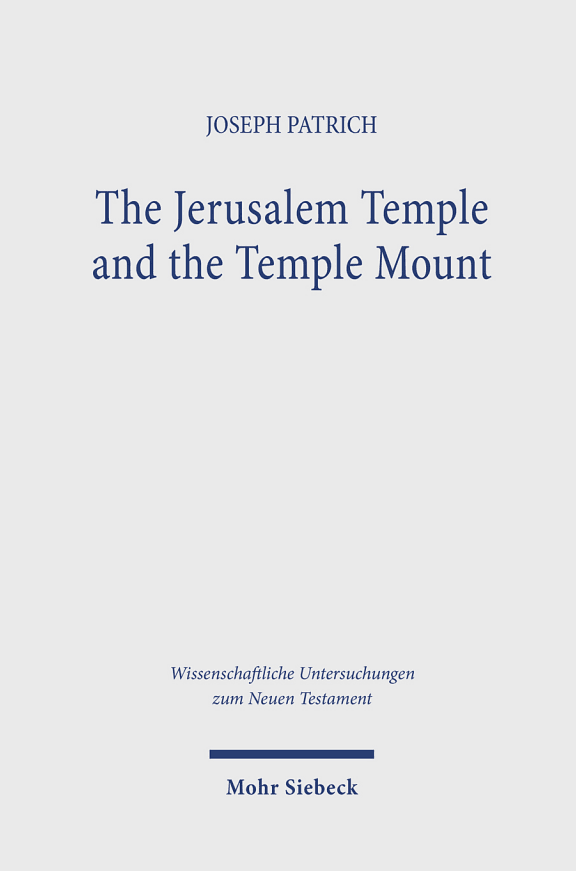
Joseph Patrich, The Jerusalem Temple and the Temple Mount. Collected Essays, Wissenschaftliche Untersuchungen zum Neuen Testament 514, Mohr Siebeck, Tübingen 2024, ISBN 978-3-16-163269-3, XIV, 334 pages (Hardback)
The Temple in Jerusalem was a central institution of biblical Judaism, which ended with its fall in 70 AD, when the forces of Titus, the future emperor, launched an armed attack on Jerusalem. Although the temple has been defunct for twenty centuries, interest in it has not waned among both Jewish and Christian scholars. A remarkable example of this is a book published by Mohr Siebeck in Tübingen in 2024, authored by Joseph Patrick, Professor Emeritus of the Institute of Archaeology at the Hebrew University of Jerusalem. The book is an exceptionally valuable contribution to the scholarly discussion of the history, architecture, and function of the Temple in Jerusalem and the Temple Mount itself. The author, a distinguished archaeologist and historian of antiquity, attempts a comprehensive approach, combining the results of archaeological research with analyses of historical and theological texts. Already in the introduction, he emphasizes that the Temple in Jerusalem has been the object of his research for over forty years, and that his interest in it is purely academic and has nothing to do with providing arguments for those who – motivated by messianic thought – dream of rebuilding the Temple (p. V).
The publication consists of four parts, titled „Introduction,” „The Temple Mount and its Courts, Gates, and Chambers,” „The Temple and its Gates and Chambers,” and „Outside the Temple Precinct.” The four parts encompass the book’s eleven chapters. The introductory sections (on pages marked with Roman numerals) include „Preface,” „Abbreviations,” and „Plates,” while the book concludes with „List of Original Publications,” „Bibliography,” „Index of Literary Sources,” „Index of Personal Names,” „Index of Geographical Names,” and „Index of Subjects.”
Part One („Introduction”; pp. 3-24) is devoted to historical and geographical issues concerning the Temple. In discussing the history of the Temple in Jerusalem, Patrick does not date back to the time of Solomon, but begins with the Persian period (538-332 BCE) and concludes with the Herodian period (37 BCE-70 CE). Although this historical sketch takes up little space, the author manages to discuss mentions of the Temple not only in the works of ancient Jewish writers (biblical and para-biblical literature) but also in Pliny (Natural History 5.70), Polybius (cited by Flavius Josephus in Antiquitates Judaicae 12.136), and Tacitus (The Histories 5.8.1). Discussing the geographical location of the Temple within the walls of ancient Jerusalem, Patrick juxtaposes the results of archaeological research with biblical data and the writings of Flavius Josephus.
In the second part (pp. 25-106), Patrich discusses four stages in the evolution of the Temple Mount: (1) the time of Nehemiah; (2) the elevation and leveling of the Outer Court by Simeon the Just; (3) the Seleucid acra; (4) the fortification of the precinct of Simeon the Just by Judas Maccabaeus and Jonathan. The author also explores the little-known issue of Simeon the Just’s project on the same hill, presents the varying „degrees of holiness” of individual temple areas (’Azara and Soreg), and presents the latest archaeological findings on the „House of Stone” (Hebrew: beth even), mentioned in the Mishnah (Parah 3:1). It should be added that this part of the book was co-authored by the architect M. Edelcopp.
The third part of Patrick’s book is the most extensive (pp. 107-246). It seems that the most important chapter in this part concerns the proposal for a new location of the Second Temple and the layout of its courts, gates, and chambers. It is true that „the exact location of the Temple on the Temple Mount is still an unresolved riddle” (p. 107). Most scholars place the Temple exactly where the Dome of the Rock stands today, but opinions differ as to whether the rock within the Dome of the Rock is the site of the Holy of Holies or the site of the altar of burnt offerings. After carefully examining the location of the cistern, which archaeologists designate as number 5, Patrich concludes: „The result is that the temple was standing more to the east relative to current opinions, so that the Rock under the Muslim Dome (which was below floor level during the Second Temple period, hidden from view) was located to the west of the temple court” (p. 126). The author also addresses the issue of the Temple’s orientation and compares the results of archaeological work with the Mishnah’s references to southern and northern chambers (Mishnah, Middot 5:3-4 and Yoma 19a). Archaeology, it turns out, can reconcile supposedly contradictory references in the Mishnah. Patrick then confronts the excavations with the Temple Scroll’s references to the House of the Laver and the House of Utensils, discusses the significance of the water wheels, and proposes a new reconstruction of the temple’s plan, placing particular emphasis on its portal. In this context, the role of the temple’s „stairs” (Hebrew: mesibbah) in light of the Middot treatise is also explored.
The final section of Patrich’s book discusses the immediate surroundings of the Temple, namely the Free Masons’ Hall (the Herodian Triclinium and fountain on the West of the Temple Mount) and the Jerusalem aqueduct.
After reading this book, written by a retired professor at Hebrew University, the school where I had the honour of studying, three reflections come to mind:
(1) Interestingly, Patrich makes no reference whatsoever to the increasingly popular (at least in the media) theses of Robert Cornuke or Ernest L. Martin regarding the location of the Temple in Jerusalem (see especially R. Cornuke, Amazing New Discoveries That Change Everything About the Location of Solomon’s Temple, 2014). These authors’ publications are not included in the bibliography at all. This is likely because Patrick decided that such a radical hypothesis should not be pursued, and besides, Gordon Franz dealt with it in great detail (https://www.lifeandland.org/wp-content/uploads/2023/07/Review-of-Cornuke-Temple-12-Twelve-1.pdf);
(2) The Mishnah, as one of the first works of rabbinic literature, began to be written decades after the fall of the Temple in 70 CE, and a process was concluded about a century later. In his book, Patrich demonstrated that the Mishnah’s records, particularly those in the tractates Tamid, Yoma, and Middot, are authentic in the sense that they are confirmed by excavated data;
(3) A major strength of The Jerusalem Temple and the Temple Mount: Collected Essays is its analysis and systematization of information about the functioning of the Temple in the pre-Herodian period, which comes from the Temple Scrolls from Qumran. The Temple Scroll was first published in Hebrew by Yigael Yadin in 1977, and its English version appeared six years later. Patrich draws on both editions, verifying and correcting the previous findings of scholars of this scroll.
Joseph Patrich’s book is a significant step forward in the study of the Jerusalem Temple. It presents not only a detailed archaeological and textual analysis but also sheds new light on long-standing, often established interpretations. The author demonstrates that many of the concepts that have dominated scholarship for years require revision and a critical examination. Joseph Patrich’s The Jerusalem Temple and the Temple Mount: Collected Essays is essential reading for researchers, students, and enthusiasts of ancient history and archaeology of the Holy Land. The book not only summarizes previous achievements but, above all, introduces new interpretations and challenges to traditional theses, forcing reflection on the understanding of the role and function of the Jerusalem Temple. It points to the need for further research and careful analysis of archaeological materials that may revise our ideas about this one of the most important places in the history of ancient Israel.
„Joseph Patrich, The Jerusalem Temple and the Temple Mount. Collected Essays, Wissenschaftliche Untersuchungen zum Neuen Testament 514, Mohr Siebeck, Tübingen 2024, ISBN 978-3-16-163269-3, XIV, 334 pages (Hardback)”, Polish Journal for Biblical Research 25 (2025) 166-169.